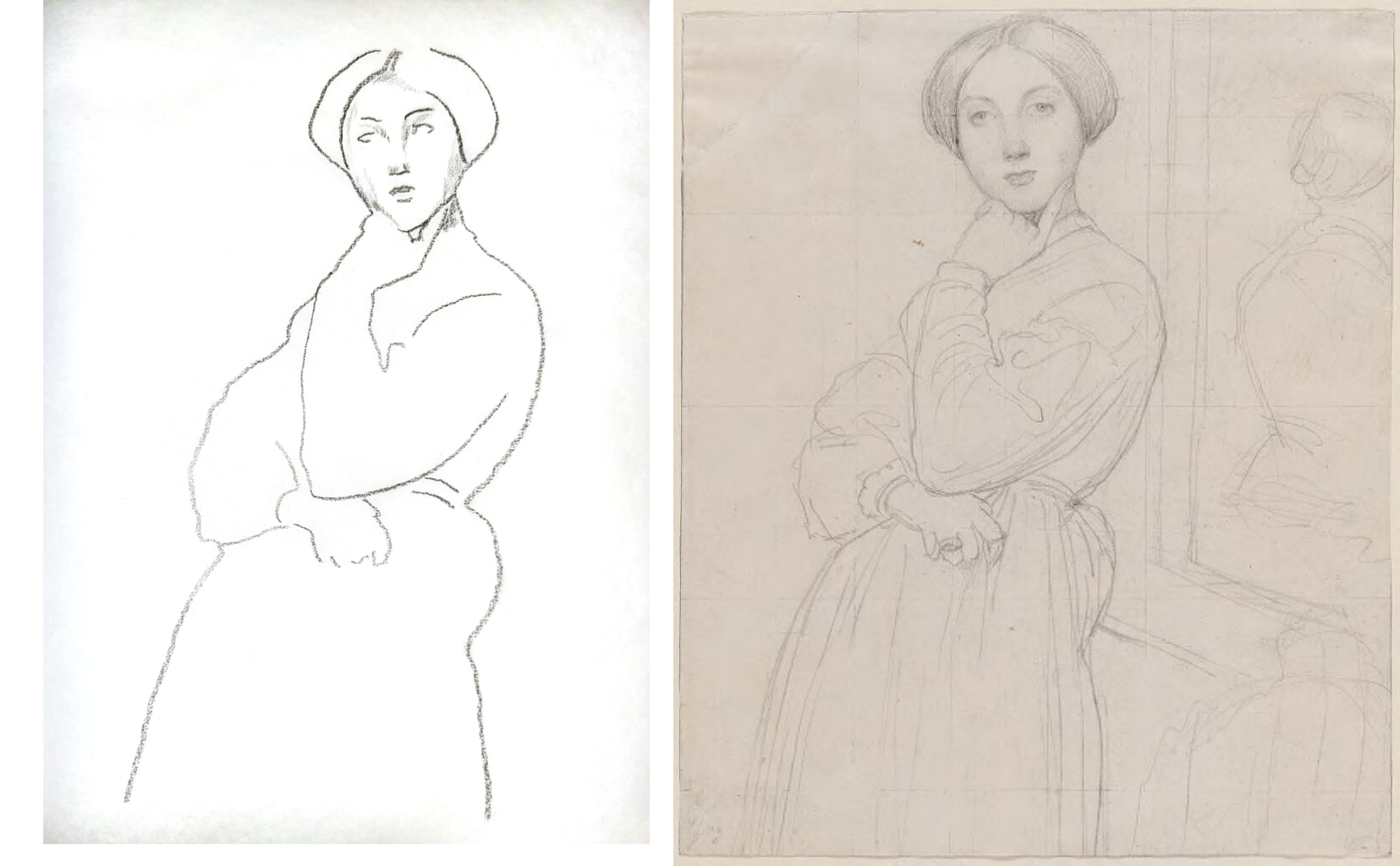
 Left: my tracing, Tuesday 13 October. Right: Jean-Auguste-Dominique Ingres, Étude pour la comtesse d’Haussonville (Study for the Portrait of Madame Othenin d’Haussonville), 1842–1845 — graphite on white wove paper, 23.4 × 19.6 cm, Harvard Art Museums, 1965.294. Public domain.
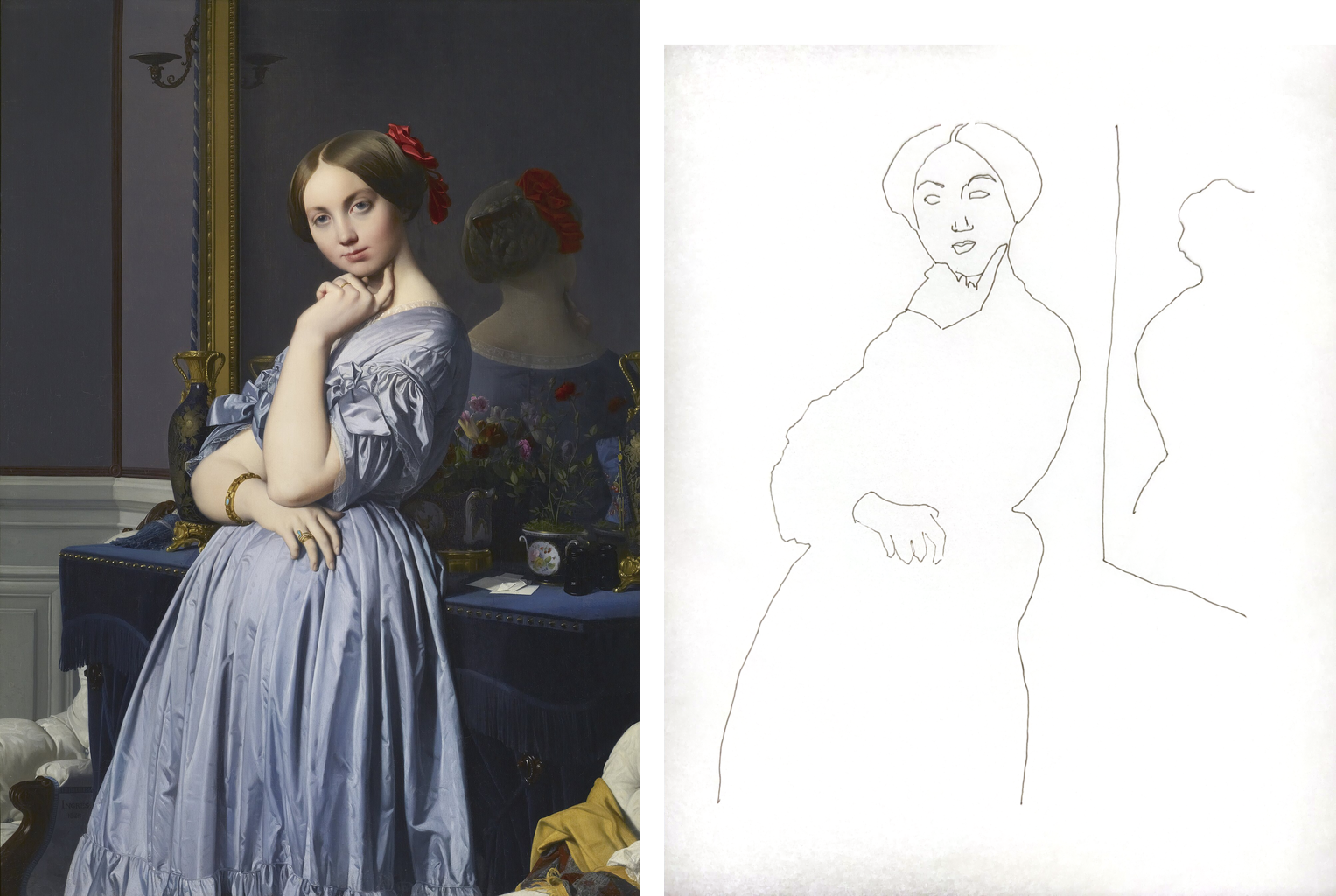
This is on the portrait of the Comtesse I did before. I was kind of looking through things to try, maybe because I drew it before, but again this one caught my eye. This time I’m going to do it in graphite.
I think as usual, I will target a kind of minimalism, but a different kind of minimalism. Here I meant minimalism involving graphite. And down here he’s got a lot of drapery, of course. Only her face gets tone, and the dress stays a contour. I think it’s not a bad plan, since the face is smoothly rounded shapes but the dress has linear folds. I think for this drawing minimalism gives you a good return on your investment. And just the basic joints, her finger. I do think the joints are very important. They are the basic orientation landmarks, I think, whereas the contours of the muscles give the finer level of expressivity and realism.
What I thought was interesting was that there is that little bit of shading on her face. That makes a nice little graphite exercise, I think. Yes, it’s shading for dimensionality. I picked this one because the shading is sort of light and minimal. For this one I wanted to go in and capture and learn to add some of this internal face shading. It’s really, really light and seems to have more value on her nose. I think Ingres may be line-oriented and think in line a lot, but clearly his first concern is the shape and form itself.
Auction
This sheet never went through a saleroom on its way to a museum. It came to the Fogg at Harvard in 1965, a bequest of Meta and Paul J. Sachs. The painting it prepares was sold once, to the dealer Georges Wildenstein after Paul-Gabriel d’Haussonville’s death, and the Frick Collection bought it in 1927 for $125,000.
Background
Jean-Auguste-Dominique Ingres drew this study between 1842 and 1845, in graphite on white wove paper, 23.4 by 19.6 cm, squared for transfer and signed “Ing” at the lower left. It is in the Harvard Art Museums (Fogg Museum, 1965.294). It prepares the Comtesse d’Haussonville of 1845, now in the Frick Collection in New York, one of an estimated eighty drawings Ingres made for the portrait, of which fifteen survive.
I traced the same sheet on Sunday 4 October, in line. That post has the story of the sitting, Ingres’s Étude pour la comtesse d’Haussonville, in line.
Links
- Study for the Portrait of Madame Othenin d’Haussonville — Harvard Art Museums, the study traced here (1965.294), and the master image
- Louise, Princesse de Broglie, Later the Comtesse d’Haussonville — the Frick Collection, another study, and the eighty drawings
- Portrait of Comtesse d’Haussonville — Wikipedia, the painting, its sitting and provenance
- Jean-Auguste-Dominique Ingres — Wikipedia
- The first tracing, Sunday 4 October — the same sheet, in line
- Process video — Tuesday 13 October — the tracing session on YouTube